Wednesday, February 5, 2020

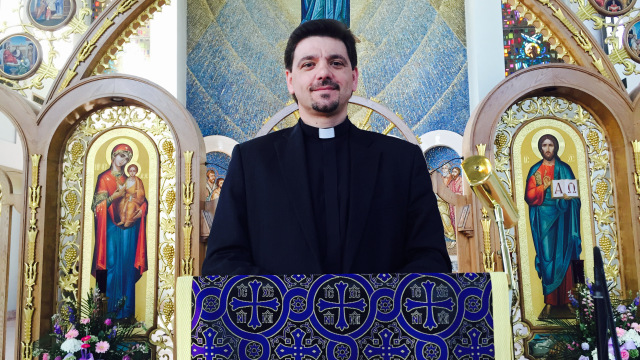
Father & Son Moment During Ordination Rite: Photo From Personal Ordinariate of the Chair of St. Peter


Source of photo from Facebook page for Personal Ordinariate of the Chair of St. Peter: https://www.patheos.com/blogs/deaconsbench/2013/07/picture-of-the-day-or-maybe-of-the-year/ (5 Feb. 2020)


But here is the excerpt from Deacon Greg Kendra's blog with Deacon Greg's commentary:

From the Facebook page for the Personal Ordinariate of the Chair of St. Peter:
Congratulations to Deacon Patrick Allen from Charleston who was ordained to the transitional diaconate yesterday. His young son decided to share in the experience with him!
Congratulations and welcome, deacon!  Ad multos annos!
UPDATE: A few people have been puzzled by the fact that this man is being ordained a transitional deacon.  How can he be married and have a child?, they ask.
He is part of the Anglican Ordinariate: a married former Anglican (or, more likely, Episcopalian) priest who converted and has received permission for ordination to the Catholic priesthood.   As the ordinariate explains it:
Anglican clergy seeking to be ordained as Catholic priests must first complete an extensive process that includes background checks; an endorsement by the local Ordinary; approval by the head of the Ordinariate and by the Vatican; completion of an approved Ordinariate formation program; and an examination. Celibacy is the norm for the clergy. Permission has been given on a case-by-case basis by the Pope for former Anglican priests who are married to be ordained Catholic priests for the Ordinariate. If widowed, they may not remarry.

JP2's Pastoral Provision & B16's Ordinariate "did not abolish celibacy": John Allen

https://youtu.be/M7ocaRmKYs8 (4 Feb. 2020) @ 20:00.

Tuesday, February 4, 2020

Top 10 Audiences For This Blog (Feb. 2020)

1 United States
2 Canada

3 Australia
4 Germany
5 Poland
6 Ukraine
7 Austria
8 United Kingdom
9 Russia
10 Slovenia

Monday, February 3, 2020

Catechism of the Catholic Church on Celibacy: Priests "Normally" Chosen From Celibate Men in Latin Rite -- that's why a dispensation from this norm is permitted; in the East, the practice of married priests "has long been considered legitimate"


1577 "Only a baptized man (vir) validly receives sacred ordination."66 The Lord Jesus chose men (viri) to form the college of the twelve apostles, and the apostles did the same when they chose collaborators to succeed them in their ministry.67 The college of bishops, with whom the priests are united in the priesthood, makes the college of the twelve an ever-present and ever-active reality until Christ's return. The Church recognizes herself to be bound by this choice made by the Lord himself. For this reason the ordination of women is not possible.68

1578 No one has a right to receive the sacrament of Holy Orders. Indeed no one claims this office for himself; he is called to it by God.69 Anyone who thinks he recognizes the signs of God's call to the ordained ministry must humbly submit his desire to the authority of the Church, who has the responsibility and right to call someone to receive orders. Like every grace this sacrament can be received only as an unmerited gift. 

1579 All the ordained ministers of the Latin Church, with the exception of permanent deacons, are normally chosen from among men of faith who live a celibate life and who intend to remain celibate "for the sake of the kingdom of heaven."70 Called to consecrate themselves with undivided heart to the Lord and to "the affairs of the Lord,"71 they give themselves entirely to God and to men. Celibacy is a sign of this new life to the service of which the Church's minister is consecrated; accepted with a joyous heart celibacy radiantly proclaims the Reign of God.72

1580 In the Eastern Churches a different discipline has been in force for many centuries: while bishops are chosen solely from among celibates, married men can be ordained as deacons and priests. This practice has long been considered legitimate; these priests exercise a fruitful ministry within their communities.73 Moreover, priestly celibacy is held in great honor in the Eastern Churches and many priests have freely chosen it for the sake of the Kingdom of God. In the East as in the West a man who has already received the sacrament of Holy Orders can no longer marry. 

_______

66 CIC, can. 1024.
67 Cf. Mk 3:14-19; Lk 6:12-16; 1 Tim 3:1-13; 2 Tim 1:6; Titus 1:5-9; St. Clement of Rome, Ad Cor. 42,4; 44,3:PG 1,292-293; 300.
68 Cf. John Paul II, MD 26-27; CDF, declaration, Inter insigniores: AAS 69 (1977) 98-116.
69 Cf. Heb 5:4.
70 Mt 19:12.
71 1 Cor 7:32.
72 Cf. PO 16.
73 Cf. PO 16.

Comment on "Married Priests, Sure But..." on (1) current celibate priests being resentful, (2) finances for married priests, and (3) transferring a married priest

Source: https://sergesblog.blogspot.com/2017/05/married-roman-rite-priests-sure-but.html (3 Feb. 2020)

The title of this blog is fitting: "Sure, but..."  The Latin rite should maintain celibacy as the 'norm' but allow dispensations on a case by case basis the way Popes Pius XII, Paul VI, JP2 and B16 have allowed married Latin rite priests.  Regarding your points above:
1.) A recent secular poll found that 6 out of 10 diocesan priests support married priests.
2.) If most or some of the married priests in the U.S. are treated financially like married permanent deacons, then this would alleviate the issue.  Married permanent deacons typically are not paid for their ministry and are expected to be stable, so married priests (who would most likely come from the married deacons) would be expected to be financially independent.  A small stipend here and there, of course, wouldn't hurt for the married priest.  [Added 5/4/2020: For Ordinariate priests, a just salary should be continued as usual.]
3.) Point granted.  Look to the married permanent diaconate and 40,000 deacons -- half of whom are in the USA).  That is what it would look like trying to transfer married priests.

Sunday, February 2, 2020

A comment, a response, and my reply to response on ChurchMilitant article about Cardinal Sarah

This is an excellent question. Based on the evidence provided by Cardinal Stickler (which I think Sarah uses for his own position), a good author of a book from Ignatius Press, we can point to 3 earliest data on 'mandated' clerical continence-- 2 of which was local and 1 of which was from a Pope in the 4th Century: Elvira in (southern modern day Spain) c. late 3rd Century or early 4th Century, Carthage in the late 300s, and Pope Siricius in the late 300s. Stickler relies on scholarship by Cochini (also published by Ignatius Press) and Cholij who I think left the priesthood after writing about celibacy. Those local councils Elvira & Carthage definitely mandated continence, but the jurisdiction pertained to those local regions and were not universal. Given these, I think it is safe to hypothesize that, while these local councils did not legislate new universal norms, it did not preclude that both celibate and married priests coexisted in their region. So to answer your question, then, no universal discipline was created, but rather it codified an existing practice in that local region. Stickler readily admits that he cannot find evidence earlier than that! Anecdotally, I have asked and commented on more traditional sites like this one asking for earlier evidence than the 4th century on 'mandated' continence, and everyone tends to cite Elvira or Siricius from the 4th Century. But all this does is shoot oneself in the foot whether mandated continence came from the Twelve Aposotles or not. Continence and celibacy appears during the time of the Twelve and the NT, but what does not appear is evidence for 'mandated' continence and 'mandated' celibacy. HOWEVER, what is more noteworthy is what 3 earlier documents on clerical discipline stated (or not state) on the conduct of clergy: the Apostolic Canons of c 217 & the Didascalia of c 250 regulate clerical requirements, but no restrictions existed there for prohibiting marital relations. Even the universal and ecumenical Council of Nicea in 325 did not prohibit married priests from having marital relations or mandate continence, but rather Nicea only stated that ordained priests could not marry after ordination which is a different matter. The silence of the evidence for mandated continence before the 4th Century is deafening. Enter B16 a couple of weeks ago. I look forward to reading him and am willing to change my mind based on what he (not Sarah) wrote in his chapter 'contribution'. If B16 is basing celibacy and continence on Josephite marriages and the Levitical priesthood, this may have some merit for celibacy and continence, but whether this affects 'mandatory' or 'compulsory' continence as coming from the Twelve Apostles remains to be seen. B16 as Pope said that celibacy comes "from an epoch close to the Apostles." When Pius XII dispensed a married man to be ordained to the Latin rite priesthood in 1952, he did not expect mandated continence from the new married Roman Catholic priest he allowed and the 5 married priests that came after him in the 12 years that followed in Germany. I don't think Ordinariate Latin rite priests were asked to be continent by B16. Benedict XVI has done the most to promote a married Latin rite priesthood.

Expanding Exceptions to the Celibacy Rule Does Not Mean Abolishing Celibacy

Source: https://youtu.be/31e4VNf78dQ (2 Feb. 2020)